
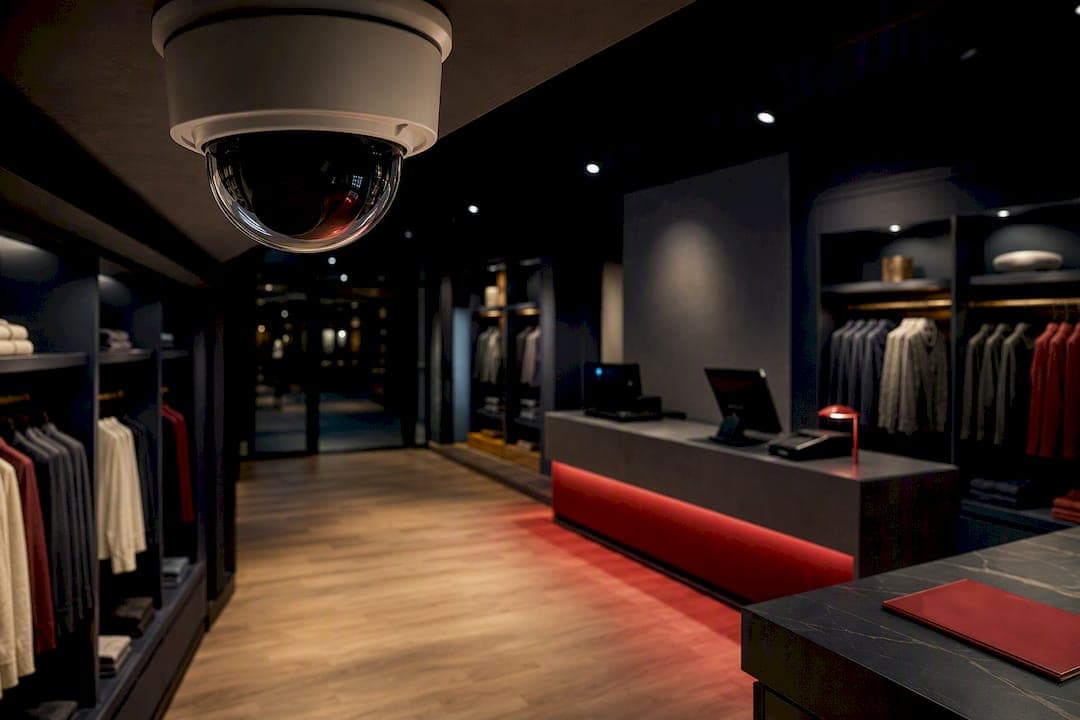
Audit-ready insurance claim documentation means two things: a defense file that proves what happened at your store with dated, unaltered evidence, and an annualized dollar exposure report that puts a number on your risk before an adjuster ever asks. One Bridge Security's free assessment builds both in about 12 minutes. The rest of this guide walks through exactly what to put in the file, how to calculate the exposure number, and how to use it once an insurer, attorney, or landlord comes asking.
TL;DR:
- Standardized site photos, a premises summary, and incident reports are essential for a credible defense file, with common failure points including missing summaries and overwritable CCTV footage.
- Quantifying liability involves selecting correct exposure bases, analyzing loss patterns, and applying simple annualization methods, but large or complex risks require actuarial assessment.
- Quick and consistent evidence collection, including timestamps and offsite backups of photos and footage, prevents credibility issues and speed up claim or renewal processes.
- Presenting a clear exposure number and structured evidence early in claims or renewals improves negotiation leverage and reduces dispute risks.
- A structured, time-efficient assessment process can produce a ready defense file in minutes, ensuring preparedness before incidents occur rather than after.
Table of Contents
- What Goes in an Audit-Ready Defense File?
- How to Quantify Your Annualized Liability Exposure
- Evidence Preservation: Photos, Video, and Chain of Custody
- Using the Defense File During a Claim or Renewal
- What Retail Assessments Keep Revealing
- Get Your Own Defense File in Minutes, Not Weeks
- Sources
What Goes in an Audit-Ready Defense File?
An adjuster or underwriter reading your file for the first time should understand your exposure in under two minutes. That means leading with a summary, not burying it in a stack of receipts.
Start with a one-page premises summary that states your headline annualized exposure number up front, followed by a short narrative of your risk profile. Everything after that page exists to back up the claim.
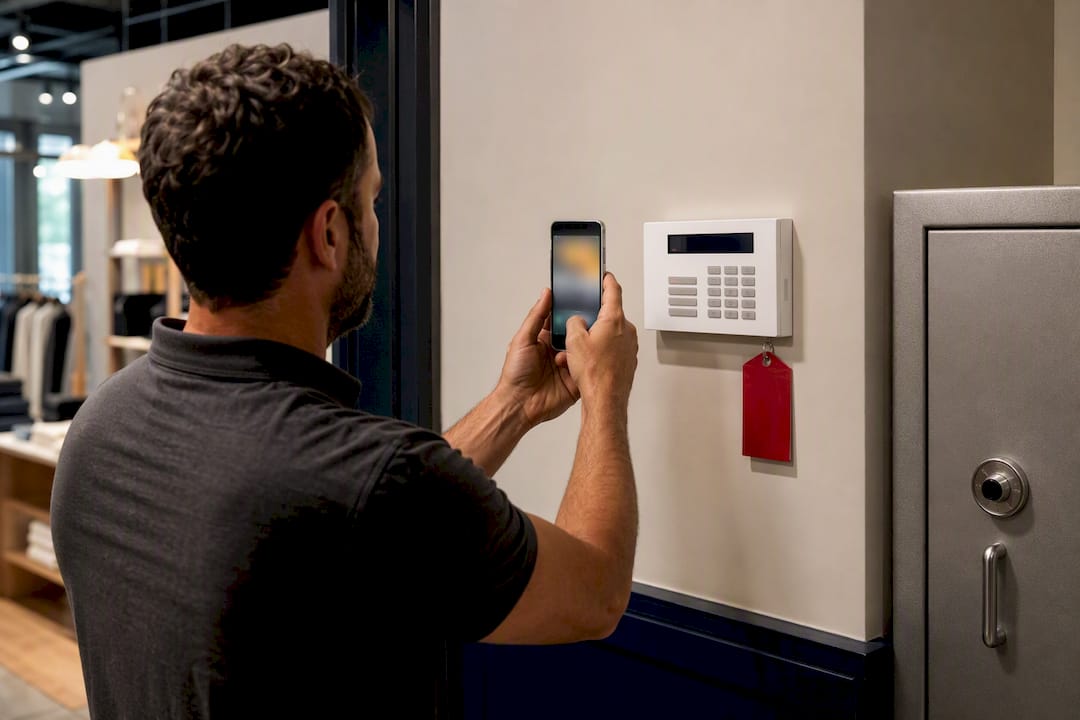
- 8 to 12 site photographs, standardized: exterior, entry points, alarm panel, safe, tills, and back office, each timestamped and unedited
- Incident reports with witness names, staff statements, and any police or fire department reports tied to the event
- Maintenance, cleaning, and inspection logs, plus employee training records showing you followed a documented safety routine
- Contracts, invoices, payroll journals, and sales reports needed to substantiate a business interruption claim
- Security system logs, CCTV retention records, and vendor service agreements proving your equipment was working and monitored
Retail loss-prevention auditors consistently find that files built around 8 to 12 standardized photos and a clear premises summary outperform bare-minimum portal submissions when underwriters push back on a claim. Skipping the summary page is the single most common reason a defense file gets read as incomplete rather than credible.
Pro Tip: Photograph your safe, alarm panel, and point-of-sale terminals every quarter, even with no incident pending. A dated baseline photo is worth more than a memory when you need to prove what your security setup looked like six months ago.
How to Quantify Your Annualized Liability Exposure
Turning a year of incidents into one defensible number takes four steps.
- Pick the right exposure base. General liability exposure is usually measured against sales volume, while workers' compensation exposure tracks payroll. Aon's retail benchmark analysis uses exactly this split when comparing loss costs across retail categories, and matching your base to the coverage type is what makes the resulting number credible to an underwriter.
- Pull one year of loss runs or incident summaries. List every incident, its estimated or settled cost, and the date. Look for patterns in frequency (how often something happens) and severity (how expensive each event runs).
- Apply a simple annualization. Take your average incident cost, multiply it by the number of incidents you expect in a typical year based on your own history, then add an allowance for allocated loss adjustment expenses, the legal and investigative costs tied to defending a claim. A store with a few incidents a year averaging several thousand dollars each, plus an allowance for ALAE, lands around a moderate annualized exposure. That single figure becomes your headline number.
- Know when to stop doing it yourself. A quick annualization works for framing a conversation with your broker or a small claim. It is not a substitute for actuarial analysis on a large loss, multi-location exposure, or anything involving bodily injury litigation. That's when you bring in a broker or actuary.
Retail cost-of-risk tends to run higher than most owners assume once workers' compensation and general liability frequency are combined. Milliman's retail cost-of-risk benchmarking breaks down exactly which drivers push severity higher across the sector, which is useful context when your number looks bigger than you expected.
Evidence Preservation: Photos, Video, and Chain of Custody
The moment something happens, your first three moves should be securing the scene, notifying your insurer, and opening a digital claim folder. Everything you collect afterward gets dropped into that folder, dated and named consistently.
For photo and video evidence, stick to 8 to 12 shots covering the same standard angles every time: entry points, the immediate incident area, before-and-after conditions if there was damage, and any equipment involved. Never edit the images. Metadata proving when a photo was taken is worth more than a sharper crop.
- Name files consistently, something like
20260214_incident_storeA_frontdoor.jpg, so anyone reviewing the folder later can sort by date and location instantly - Back up everything offsite, not just on the DVR that lives in your back office
- Keep receipts for any mitigation work (board-up, locksmith, cleanup) as proof you acted to limit the loss
- Log physical evidence with a simple chain-of-custody note: who found it, when, and where it's stored now
The two errors that undermine credibility fastest: CCTV footage that gets overwritten before anyone pulls it, and mitigation work with no invoice trail. Both make an otherwise solid claim look improvised.
Pro Tip: Set your DVR retention to at least 30 days and calendar a reminder to pull footage the same day anything happens. Most retail systems overwrite on a rolling loop, and footage lost to that loop cannot be recreated.
Using the Defense File During a Claim or Renewal
A defense file only earns its keep if you use it at the right moments, in the right order.
- Open with a one-page cover. Lead your initial claim contact with the headline exposure number and a two-paragraph summary of what happened. Adjusters read hundreds of files; give them the conclusion first.
- Submit evidence in a logical order. Photos and video first, then incident and witness statements, then supporting logs and financial records. Whether it goes through a portal or email, structure matters as much as content.
- Anticipate standard requests. Adjusters typically ask for proof-of-loss statements, inventories, and mitigation receipts. Insurance Curator's claim-filing guide lists these as the documents that most often slow simple claims down when they're missing, and a complete defense file pre-answers nearly all of them.
- Respond fast to a reservation of rights letter. If an insurer sends one requesting supplemental proof, your existing file usually already contains the answer. Send it promptly rather than scrambling to reconstruct records.
- Bring it to renewal, not just to a claim. A quantified exposure number and a documented control history give your broker something concrete to negotiate with, Order when it comes to matching coverage to your actual scored risk.
What Retail Assessments Keep Revealing
The same three gaps show up again and again across independent retailers: security footage that got overwritten before anyone thought to save it, incident reports with no timestamp, and mitigation work with no invoice to prove it happened. None of these are expensive fixes. They're habits.
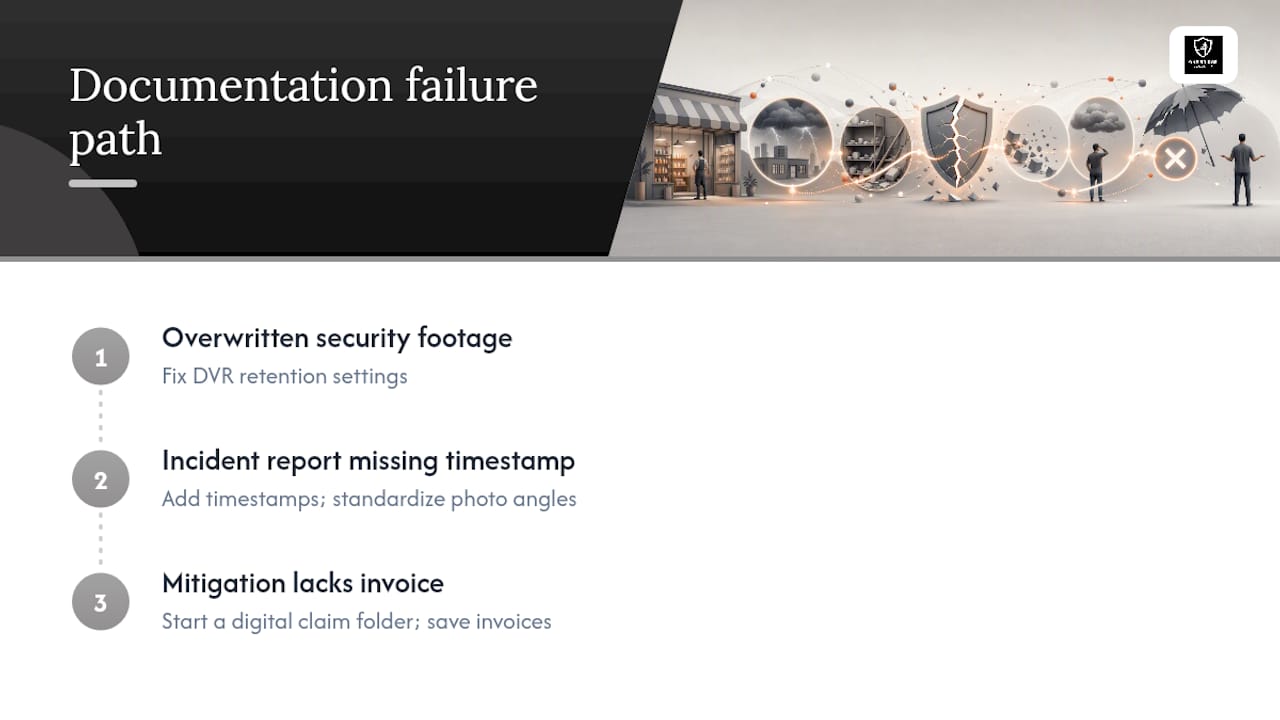
What's striking is how fast a store can go from exposed to defensible. Fixing DVR retention settings, standardizing your photo angles, and starting a digital claim folder is a few hours of work, not a few weeks. The stores that treat documentation as a quarterly habit rather than a post-incident scramble consistently produce cleaner files when it actually matters.
That's the real value of a structured assessment. It doesn't just tell you where you're exposed, it puts a number on it and generates the file structure automatically, so you're not building one from scratch under pressure after something has already gone wrong. A clear number and contemporaneous evidence turn a claim into a straightforward review instead of a dispute over whose version of events is correct.
— Fonz
Get Your Own Defense File in Minutes, Not Weeks
Onebridgesecurity turns everything covered above into a done-for-you process: no manual folder structure, no guessing at your exposure number, no waiting on a broker call to find out where you stand. The free self-assessment takes about 12 minutes and produces a category-specific checklist, a Colorado crime-data-informed vulnerability score, and an annualized dollar exposure report you can hand directly to an insurer or attorney.
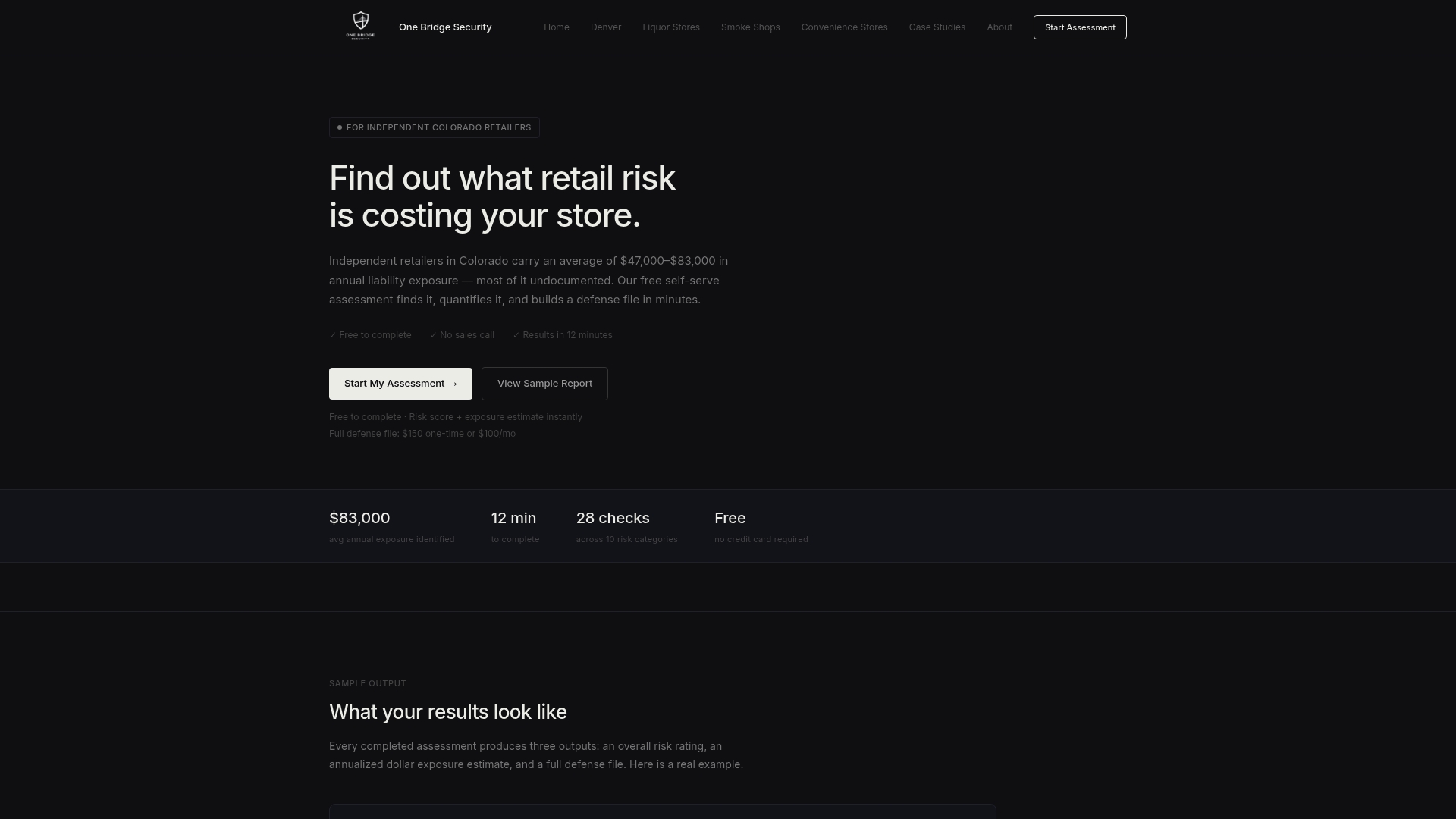
If you want to see the output format before you start, the sample risk assessment report shows exactly how the defense file and exposure number are presented, and the case studies walk through how that documentation changed real claim and renewal outcomes for other independent retailers. Liquor store owners can start with the liquor store risk assessment built specifically for that category.
Start your free retail risk assessment now and have your defense file and exposure number ready before the next incident, not after.
Sources
This guide draws on a handful of industry benchmark reports and practical claim guidance rather than opinion. Chubb's liability limit and large-loss benchmark report frames what liability limits and large losses look like across sectors. Milliman's retail cost-of-risk analysis explains what drives frequency and severity in retail. Aon's retail benchmark analysis supports the exposure-base methodology used here. Insurance Curator's claim-filing guide informs the operational timeline, and Order supports matching coverage to scored risk.
- Milliman — Retail cost of risk (benchmark analysis)
- Aon — Retail Benchmark Analysis (2019)
- Insurance Curator — Business insurance essentials: how to file a commercial claim
- Order