

An insurance claim denial appeal succeeds far more often than most independent retailers assume, provided the appeal replaces emotion with an organized, audit-ready evidence package mapped point by point to the denial letter. The first move isn't a phone call to your adjuster. It's securing that denial letter, opening a dated evidence folder, and starting an exhibit index today. Resources like One Bridge Security, and guidance from writers like Fonz, exist specifically to make that first hour less overwhelming.
TL;DR:
- Successful appeals hinge on organizing evidence point-by-point to the insurer's specific denial grounds, especially quoting exact policy clauses and exclusion language.
- Detailed, consistent visual and financial documentation, including pre-loss financials and independent reports, significantly strengthen your appeal case.
- Request and thoroughly review your claim file for inconsistencies before re-approaching insurers, and escalate within legal or regulatory channels if initial appeals fail.
- Maintaining daily incident records, photo habits, and up-to-date folders can prevent evidence gaps that lead to denials and simplify future appeals.
- Building an evidence package in advance using tools like OneBridge Security allows you to respond swiftly within insurer response windows, increasing chances of claim success.
Table of Contents
- What goes into an audit-ready insurance appeal package?
- How do you write an insurance claim appeal letter that gets read?
- How do you calculate business-interruption exposure for a small retail store?
- How do you request an insurer's claim file and audit it?
- What happens if the appeal is denied again?
- The daily habits that make appeals easy later
- Build your defense file before you need it
- Sources
What goes into an audit-ready insurance appeal package?
Every successful insurance claim denial appeal starts with the same move: reading the denial letter line by line and pulling out the exact grounds the insurer cites. Insurers rarely deny a claim on vague suspicion. They point to a specific exclusion, a valuation dispute, or a documentation gap, and your entire appeal should map back to those specific words.
Start with your policy materials. Pull the declarations page, every endorsement, and the denial letter itself, then highlight the precise clause the adjuster referenced. If the letter cites "insufficient proof of loss," that phrase tells you exactly what to fix.
Photo and video evidence needs a consistent standard, not a phone full of random shots. For every damaged area, capture:
- A wide shot showing the location in context
- A mid-range shot showing the affected section
- A close-up showing the specific damage, with a ruler or object for scale
Keep timestamps and location metadata intact, and back up copies somewhere off-site, not just on the phone that took them.
Pre-loss financial records matter just as much as post-loss photos. Gather monthly profit and loss statements, POS sales reports, bank and deposit records, payroll registers, and two to three years of tax returns. These prove what your business looked like before the incident, which is the baseline every exposure calculation depends on.

Round out the file with independent evidence: police or fire reports, at least two contractor repair estimates, and professional reports where the loss warrants one. Build a numbered exhibit index and a communications log noting every call and email, since contemporaneous documentation plans reduce disputes and speed recovery. A retail loss prevention audit built before an incident makes this exercise dramatically faster after one.
How do you write an insurance claim appeal letter that gets read?
Your appeal letter's job is narrow: force a human reviewer, not an algorithm, to look at your file again. That happens when the letter is organized around the insurer's own denial language rather than your frustration with it.
Start with the basics up top: policy number, claim number, date of loss, and delivery by certified mail with copies sent to your broker or agent. That paper trail matters if you escalate later.
Structure the body in this order:
- A short opening paragraph stating what you're demanding (claim reconsideration, specific payment amount, or reopening the file)
- A point-by-point response to each denial ground, quoted directly from the insurer's letter, followed by your rebuttal and matching exhibit numbers
- Precise citations to the policy language that supports your position, not paraphrases
- A numbered list of every attached exhibit, so nothing gets lost in the shuffle
If the insurer denied for a documentation gap, attach the pre-loss financials and photos that address this concern. If they cited an exclusion, quote the exact exclusion language back and explain why your loss falls outside it. If it's a valuation dispute, attach your independent contractor estimates and any quantified exposure figures you've calculated separately.
Keep the tone flat and factual. No adjectives about how this has "devastated" your business, just the facts and the citations. Close by requesting a written response within a reasonable timeframe. Insurance and legal professionals consistently note that a demand letter addressing each denial point head-on, with attached exhibits, prompts insurer reconsideration more reliably than a general complaint.
Pro Tip: Number your exhibits to match the paragraph numbers in your letter, so "See Exhibit 4" always means the same document. Adjusters skim; a mismatched index kills your credibility instantly.
How do you calculate business-interruption exposure for a small retail store?
Business-interruption claims live or die on your books, not on your policy limit. Insurers reconstruct what your revenue would have been without the loss, and if your records force them to guess, they'll guess low.
The records that matter most:
- Multiple years of monthly profit and loss statements
- Daily or weekly sales reports broken out by category
- Payroll records covering the loss period and the months before it
- Lease and loan obligations that continued during the closure
- Documentation of any expenses you saved by not operating, and any extra expenses incurred to keep operating
The calculation itself doesn't need to be complicated. Choose a baseline period (typically the same months the prior year, adjusted for any known seasonal swings), subtract expenses you didn't have to pay during the closure, add any extra costs from mitigating the loss, and present the math in a simple table with your assumptions spelled out. A reviewer who can follow your logic in thirty seconds is far more likely to approve it.
Insurers reconstruct baseline revenue from documented financials, and a common reason BI claims fail isn't a coverage gap. It's incomplete cash reconciliation or missing receipts that leave the adjuster with nothing solid to calculate against.
For losses running into six figures, or where the insurer disputes your restoration timeline, a forensic accountant's independent report often carries more weight than anything you submit yourself. Their credential alone changes how the file gets reviewed internally.
How do you request an insurer's claim file and audit it?
You have the right, in most states, to request the complete claim file the insurer built on your case. Send that request in writing, referencing your claim number, and ask specifically for adjuster notes, internal photos, valuation worksheets, and any third-party reports the insurer commissioned.
Once you have it, read it looking for gaps, not just conclusions:
- Dates that don't match your own timeline of events
- Photos that are missing, blurry, or taken from angles that undersell the damage
- Valuation assumptions that ignore your submitted estimates
- Notes referencing evidence you never actually submitted, or omitting evidence you did
Policyholders who request their full claim file often uncover inconsistencies that support an appeal, particularly when internal notes contradict the stated reason for denial. Log every call and email with the insurer, including the date, the representative's name, and a one-line summary, and always confirm in writing that your appeal packet was received. If the file shows a genuinely disputed valuation or a technical judgment call you can't evaluate yourself, that's the point to bring in an independent expert for a second opinion.
What happens if the appeal is denied again?
A second denial isn't the end of the road, but it does change your calculus. The escalation path generally runs in three stages: internal reconsideration by a senior claims reviewer, a complaint to your state's Department of Insurance, and finally appraisal, mediation, or litigation.
Calendar your deadlines the moment you get a second denial. Most states set firm windows for regulator complaints and for invoking appraisal clauses, and missing one can forfeit your leverage entirely.
Escalate when you have a strong independent report in hand, when the insurer has violated its own claims-handling procedures, or when the policy language is genuinely ambiguous rather than clearly against you. At that point:
- A public adjuster can negotiate on your behalf, usually for a percentage of the recovery
- A coverage attorney becomes worth the cost once litigation is realistically on the table
- A forensic accountant's report often justifies its fee in a BI dispute alone
The daily habits that make appeals easy later
Most retailers I've watched go through an appeal weren't undone by a weak case. They were undone by evidence they never captured in the first place. A daily photo habit, five minutes at close, paired with same-day cash reconciliation, does more for your future appeal than any letter template ever will.
Keep incident folders labeled by date the moment something happens, not weeks later when memory fills the gaps. A structured self-assessment that runs in about 12 minutes can surface documentation gaps before they ever cost you a denial.
— Fonz
Build your defense file before you need it
Onebridgesecurity is the fastest route to the exact evidence package this article walks through, without hiring a consultant or building spreadsheets from scratch. The free self-assessment generates an annualized dollar exposure report, a category-specific checklist built for liquor stores, smoke shops, or convenience stores, and a defense file structured the way adjusters and attorneys actually expect to see one.
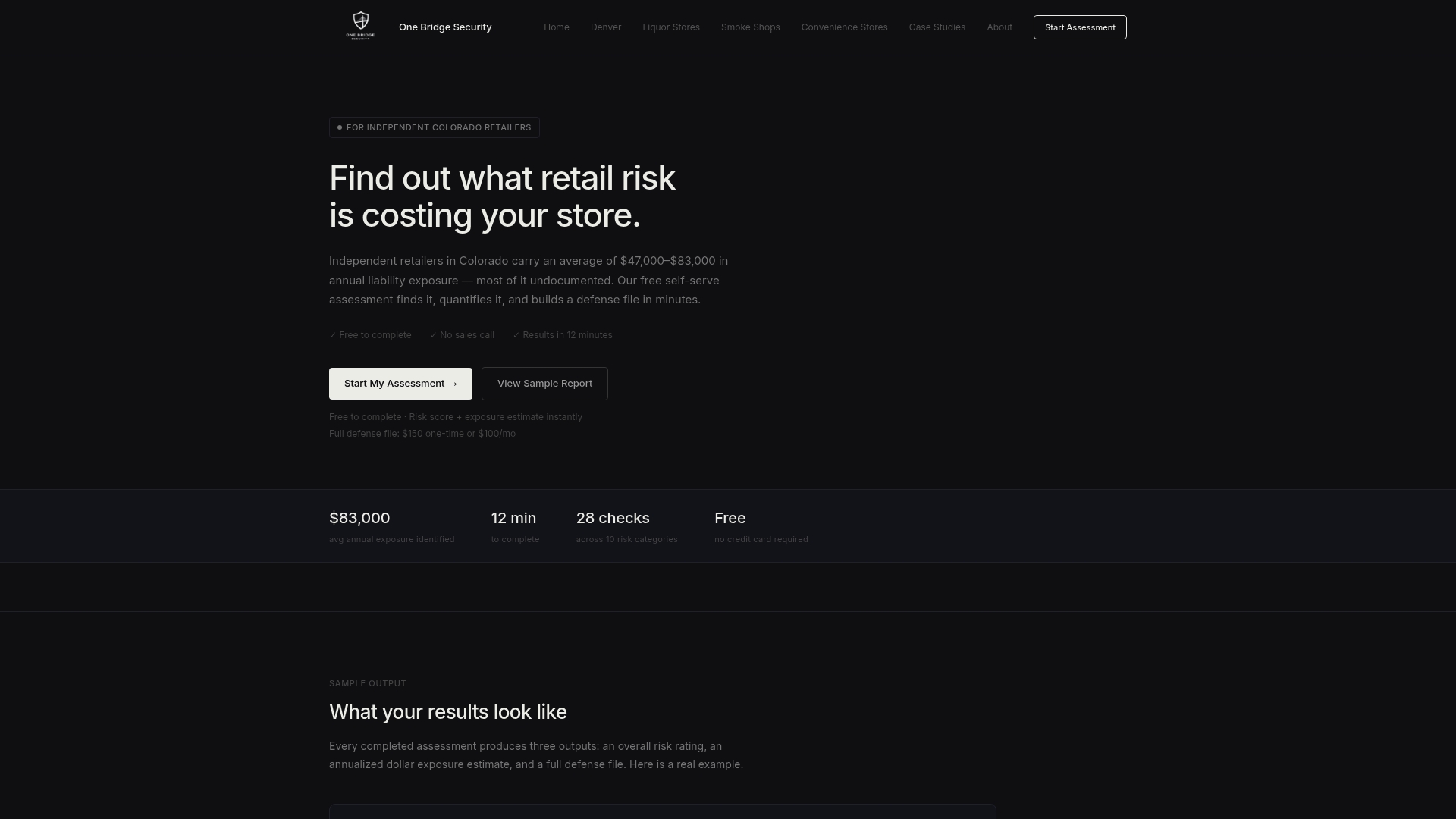
Because results come back in about 12 minutes, you can have an exhibit index ready to attach to an appeal well within the 14 to 30 day response window insurers typically get. If you're mid-appeal right now, start with the free retail risk assessment to see what a completed report looks like, or review a sample risk assessment report first if you want to see the output before you commit your own data.
Sources
- Insurance Claim Recovery Steps for Faster Payouts | BDO
- How to Write a Demand Letter That Gets an Insurer�27s Attention after a Denial? – Insurance Curator
- Business-interruption insurance clean books guide | Beancount (blog)